Quick answer: CCU stands for Concurrent Users — the number of players inside a Roblox game at one specific moment. It’s a live snapshot, not a running total. If a game shows 50,000 CCU right now, that’s exactly how many people are connected to its servers this second — not today, not this week, right now.
For the broader concept of live player numbers in general — including how to check them and what real counts look like across the platform — see our complete guide to Roblox player count. This piece goes deeper specifically into CCU as a formal metric.
That simple definition is where most explanations stop. It’s also where they start being misleading. CCU is one of the most quoted — and most misunderstood — numbers in the entire Roblox ecosystem, and getting it wrong leads developers to optimize for the wrong thing entirely. This guide covers what CCU actually measures, how it compares to the metrics people confuse it with, what real CCU numbers look like at every scale, and — critically — what CCU does and doesn’t tell you about whether your game is actually growing.
What CCU actually measures
CCU is a point-in-time count. Every player currently connected to a specific experience’s servers counts toward that experience’s CCU at that instant. Close the game, and you drop out of the count immediately — there’s no delay, no smoothing, no averaging.
That immediacy is both the appeal and the limitation. CCU tells you exactly how busy a game is right now. It tells you nothing, by itself, about:
- Whether those players are new or returning
- How long they typically stay
- Whether the number is trending up or down over weeks
- Whether the game is actually retaining anyone
A game can hit a huge CCU spike from a single viral moment and lose nearly all of it within days. Treating a snapshot like a trend is the single most common mistake people make with this metric.
CCU vs. the metrics people confuse it with
| Metric | What it actually counts | Time window |
|---|---|---|
| CCU | Players connected right now | This instant |
| DAU (Daily Active Users) | Unique players who opened the game at any point today | 24 hours |
| MAU (Monthly Active Users) | Unique players over the past 30 days | 30 days |
| Visits | Total number of times the game was joined (cumulative, all-time) | All-time, never resets |
| Favorites | Players who favorited the game | All-time |
Update: Rotrends has announced on its own site that the service will be deprecated on August 31. If you’re currently relying on Rotrends for CCU tracking, it’s worth lining up a replacement before then rather than after — see our full comparison of analytics tools for options that cover similar ground.
DAU is always going to be a much bigger number than CCU, because it’s counting everyone who dropped in at any point across a full day, not everyone at once. If someone tells you “Roblox has 10 million players,” check whether they mean CCU (everyone online at that exact second) or DAU — they’re wildly different figures, and platform-wide reporting mixes them up constantly.
As of mid-2026, Roblox’s platform-wide concurrent player count typically swings between roughly 7 million during quiet weekday mornings and up to 16 million during peak weekend evenings — and that’s CCU, the “right now” number, not a daily or monthly total.
How big can CCU actually get? Real numbers, real records
Numbers in the abstract don’t mean much, so here’s what CCU looks like at the extremes.
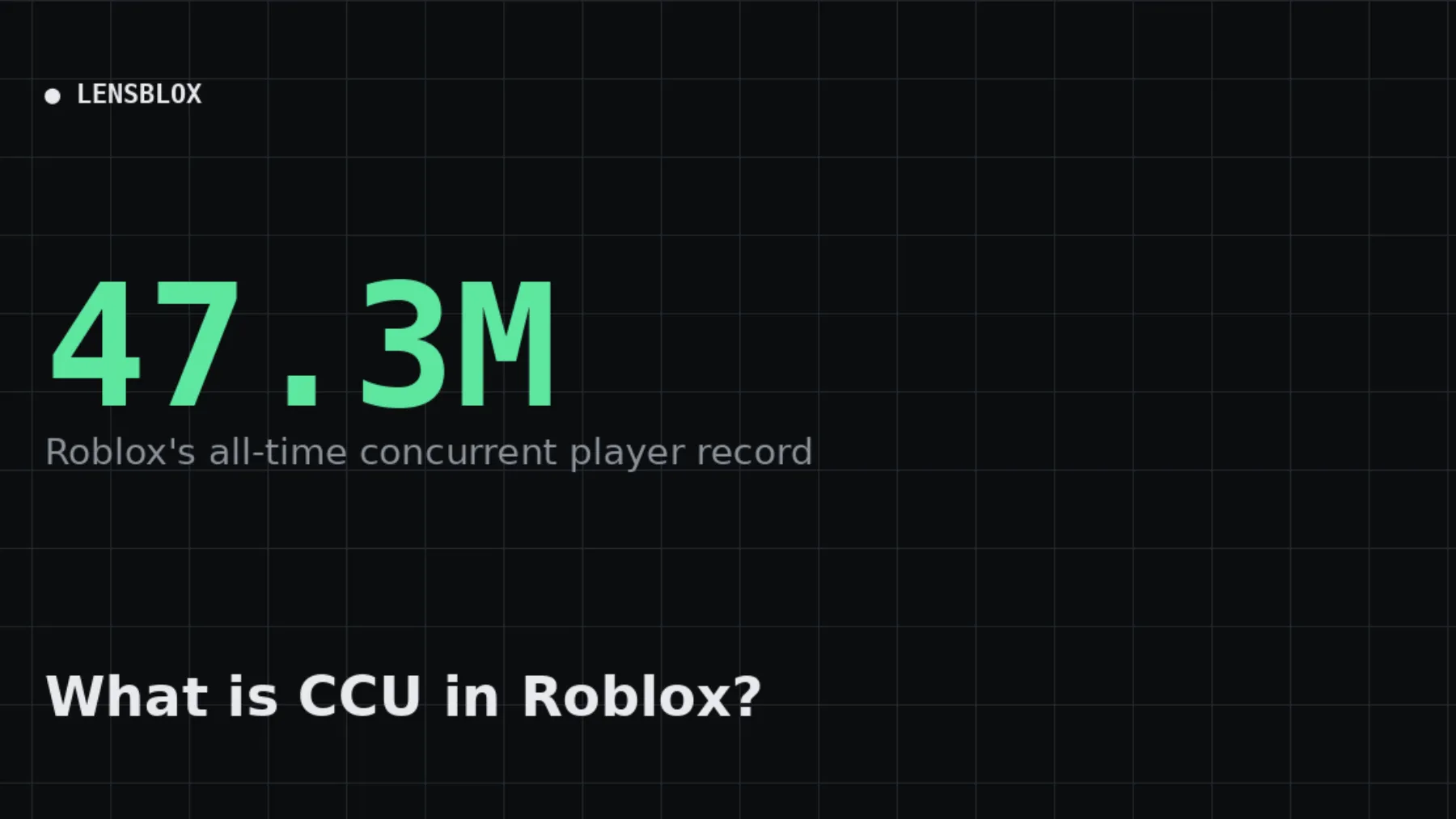
Roblox as a platform set an all-time concurrent user record on August 23, 2025, reaching roughly 47.3 million simultaneous players — a figure driven not by a scheduled event but by a head-to-head competition between two of its biggest experiences, Grow a Garden and Steal a Brainrot, each trying to out-draw the other during a live event window. Grow a Garden peaked at over 22 million concurrent players that weekend, surpassing Fortnite’s previous concurrent-user record of roughly 15.3 million. That individual-game record didn’t last long, either: in October 2025, Steal a Brainrot pushed past it again, reaching 25.8 million concurrent players — still the highest CCU ever logged for a single video game as of mid-2026.
For context on what’s “normal” versus “extraordinary”: a single Roblox game holding a few hundred live players at any moment is a healthy, functioning small-to-mid experience. A game in the low thousands is doing well. Getting into the tens of thousands puts a game among the platform’s most-played experiences at that moment. The jump from there to millions is reserved for a small handful of platform-defining hits — and even among those, CCU is famously volatile. Brookhaven, one of Roblox’s longest-running social roleplay games, has historically been one of the few experiences capable of sustaining concurrent counts in the hundreds of thousands for years at a stretch, which is part of why it keeps showing up at or near the top of every “most played” chart despite having launched years before most of its competitors.
Does higher CCU mean your game ranks better in search or discover?
This is the part almost every other explanation of CCU gets wrong, and it matters enormously if you’re a developer trying to grow.
For years, the working assumption across the developer community was straightforward: more concurrent players signals a more successful game, so the algorithm must reward high CCU with better placement in Discover and search. Chase CCU, get recommended more, grow faster.
That assumption is outdated. Multiple independent trackers monitoring Roblox’s discovery behavior through 2026 have found that the platform’s ranking weight has shifted decisively toward session return rate — specifically, the percentage of players who leave a game and come back within a 24-to-72-hour window — rather than raw concurrent player counts. A game with a modest CCU but a high rate of players returning the next day can out-rank a game with a much larger, splashier concurrent count but weak return behavior. Several developers who built for peak CCU in the old model have reported watching high-CCU games fall out of Discover placement entirely once this shift took hold, precisely because they were optimizing for a number the algorithm no longer weights heavily.
This distinction is also why CCU and search ranking are two different conversations entirely. Roblox’s Discover feed (the recommendation surface) and Roblox’s search results (what comes back when a player types a keyword) are related but separately-behaving systems. A game can have excellent CCU and still rank poorly for the exact keywords players are searching for it by — because search position depends on relevance and competition for that specific term, not on how many people happen to be playing at a given moment. This is a distinction most CCU guides skip entirely, and it’s the reason CCU alone is a dangerous number to optimize your entire strategy around.
Beyond the headline number: What to actually track
If a single CCU snapshot is this unreliable on its own, what should you actually be watching? A few derived metrics give a far more honest picture of whether a game is healthy:
- Average daily CCU, smoothed over a week — flattens out daily noise and shows real direction
- CCU floor — your lowest concurrent count during off-peak hours; a rising peak sitting on top of a falling floor is a classic sign of a game that’s spiking with new users but failing to retain them
- Peak-to-floor ratio — how dramatically your CCU swings between busy and quiet hours; extreme swings usually mean weak retention outside of specific promoted moments
- CCU velocity — the day-over-day rate of change, which shows momentum in either direction well before it’s obvious from the raw number alone
None of these require anything exotic to track — they just require watching the number over time instead of taking a single screenshot of it and calling it an analysis.
How to check any Roblox game’s CCU
Roblox doesn’t publish a historical CCU chart inside the platform itself — the in-game and website player count you see on an experience’s page is a live number, and there’s no built-in way to see how it looked yesterday or last month. To see trends over time, developers typically rely on third-party tracking tools that poll Roblox’s public data on a schedule and log it. Coverage, update frequency, and historical depth vary by tool, so it’s worth checking what window of history a given tracker actually retains before relying on it for anything more than a spot-check.
Rotrends Is Shutting Down — What to Use Instead
If Rotrends was part of your regular tracking setup, you’ll need an alternative before August 31. The good news: the gap it leaves is narrow enough that one or two other tools cover most of the same ground.
- For trending/genre-level insight (Rotrends’ core use case) — GGAID and RoLearn both surface trending games and genre momentum, with RoLearn adding ML-based forecasting on top.
- For raw CCU history and charts — RTrack updates roughly every 30 seconds if you want the highest resolution; GGAID updates every 10 minutes and covers a much larger catalog of games.
None of these are a perfect one-to-one replacement — see our full tool comparison for a closer look at what each one does and doesn’t cover before you commit to one.
Frequently Asked Questions
Is CCU the same as “players online”? Yes — CCU and “concurrent players” or “players online” all refer to the same thing: how many people are connected to a game’s servers at one moment.
What’s a good CCU for a Roblox game? There’s no universal threshold — it depends entirely on genre and scale. A few hundred concurrent players is a legitimately healthy small game. Low thousands is a strong mid-size experience. Context (how long the game has existed, how it’s trending, how it compares to similar-genre games) matters more than the raw number in isolation.
Does CCU directly affect Roblox’s search or Discover ranking? Not in the simple, direct way most developers assume. Current evidence points to session return rate mattering more than raw CCU for discovery placement, and search ranking depends on keyword relevance and competition rather than concurrent player count at all.
Is Rotrends shutting down? Yes — Rotrends has confirmed on its site that it will be deprecated on August 31. Users relying on it for CCU or trend data should plan a switch before then.
Why does my game’s CCU jump around so much? Time of day, day of week, and any promotion or viral moment all cause CCU to swing. This is normal — it’s why tracking CCU as a single number is less useful than tracking it as a trend over time. We cover how to read those trend patterns here.
Curious where your own game actually ranks for the keywords players are searching — separately from CCU or Discover placement entirely? LensBlox tracks real Roblox search rankings, with the methodology behind every score shown, not hidden behind a black box.
Get the complete Roblox discoverability guide.
Everything in this article, plus the full strategy — built from real ranking data, not recycled advice. Free.