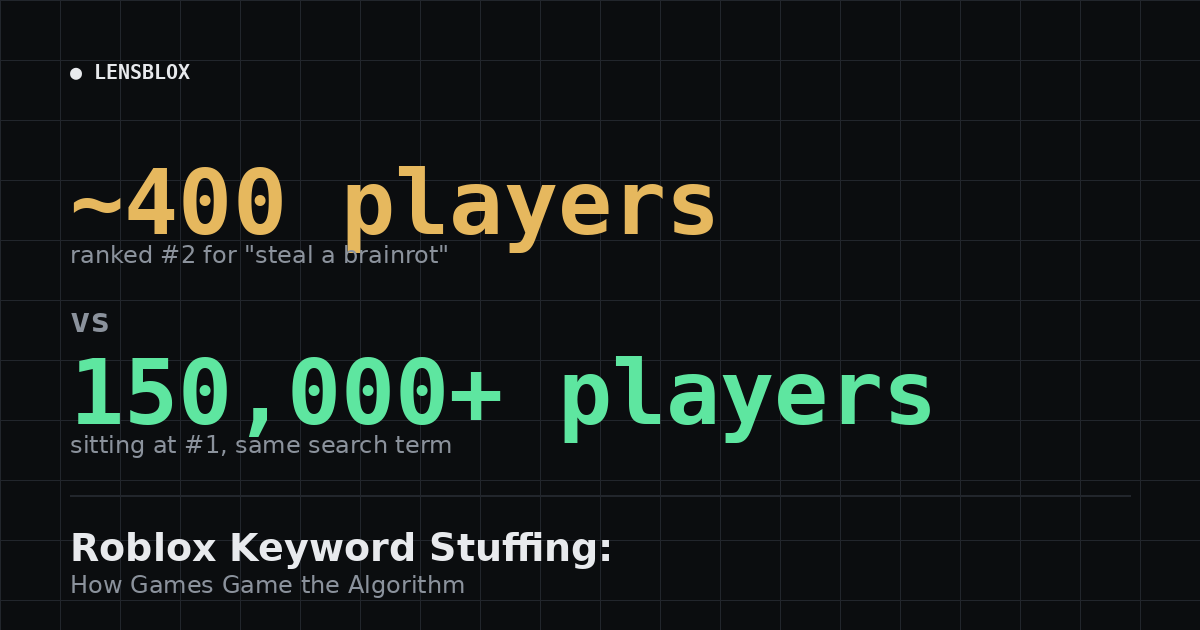
Search “steal a brainrot” on Roblox and you’ll find the real experience with that exact name sitting at #1, with well over 150,000 live players — completely expected. What’s less expected is what shows up at #2: a game called “Stealz Lucky Blocks Brainrotz FREE OG 💸,” with roughly 400 players at the time it was captured. Weaker by almost every visible measure, and still outranking dozens of other, more substantial games for that search term. That’s keyword stuffing, observed directly, not theorized about.
What Keyword Stuffing Actually Looks Like
The pattern is consistent once you know what to look for: a title that crams in every plausible variation of a popular search term — misspellings, symbol substitutions, multiple related keywords strung together — regardless of whether it reads naturally or describes the game at all. Pair that with weak engagement signals (a rough like ratio, low player count relative to competitors) and you’ve got the profile: a title built to match search queries rather than to describe a real experience.
Why This Seems to Work, At Least Partially
This isn’t fully understood, and it’s worth being honest about that rather than pretending otherwise. The most likely explanation, based on what we’ve observed about how search ranking works, is that keyword relevance matching carries real weight in the ranking system — and a title stuffed with exact-match terms can score well on relevance even when every other quality signal is weak. Whether this is a gap the algorithm hasn’t caught up to yet, or simply how much weight text-matching carries relative to everything else, isn’t something we can say with certainty. What we can say is that the pattern shows up repeatedly in real captured data, not as a one-off fluke.
How to Spot It When You’re Checking Your Competition
A few signals tend to travel together in stuffed titles:
- The title reads like a list of keywords rather than a name a player would actually type or remember
- Heavy use of symbols, brackets, or emoji clusters wrapped around the keyword terms
- A like ratio noticeably lower than other results at similar or higher rank
- A live player count far below what the ranking position would suggest, especially outside the very top spot
None of these alone is proof — plenty of legitimate games use emoji or brackets stylistically. It’s the combination, especially low engagement paired with high keyword density, that’s the real tell.
Should You Do This Yourself?
We’d steer away from it, for reasons beyond just “it might stop working.” A stuffed title actively works against you in every other context that matters: it looks unprofessional to players actually deciding whether to click, it undermines the trust signals that seem to matter for retention (which increasingly matters more for Discover placement specifically), and there’s no guarantee the pattern that works today keeps working as Roblox’s ranking system evolves. Optimizing a title to be genuinely clear and keyword-relevant — without crossing into obvious stuffing — captures most of the same relevance benefit without those downsides. Our guide to choosing a title that actually ranks covers where that line sits.
What to Do If a Stuffed Title Is Outranking You
Beyond the obvious (don’t panic and don’t copy the tactic), the more useful move is understanding that positions outside the very top spot are genuinely volatile — our own tracking found an average of 2.5 new entrants and 4.8 reshuffled positions per keyword within just 48 hours. A stuffed title sitting at #4 today isn’t necessarily permanent competition — it’s worth tracking whether it holds that position over time before assuming it’s an unbeatable rival.
Frequently Asked Questions
Does Roblox penalize keyword stuffing? There’s no confirmed, published policy specifically addressing this for search ranking, and the pattern’s continued presence in real results suggests enforcement, if it exists, isn’t comprehensive.
Is using multiple relevant keywords in a title always keyword stuffing? No — using genuinely descriptive, relevant terms is normal and reasonable. The distinction is density and intent: describing your game clearly versus cramming in every search variation regardless of readability.
Can I report a game for keyword stuffing? Roblox’s standard content-reporting tools exist for policy violations generally, but keyword stuffing in a title isn’t clearly a defined violation category — it sits in a gray area rather than a clear-cut rule break.
Spotting exactly which competitors are winning on keyword-matching alone versus real engagement is precisely the kind of signal LensBlox flags automatically — with the methodology behind every flag shown, not hidden behind a black box.
Get the complete Roblox discoverability guide.
Everything in this article, plus the full strategy — built from real ranking data, not recycled advice. Free.