Roblox’s search bar is one of the least documented parts of the entire platform. Ask ten developers how it decides what ranks first, and you’ll get ten different theories — most of them folklore passed around the DevForum rather than anything actually verified against real data. This guide is built from direct observation of Roblox’s own search results over time, not speculation, and it covers what genuinely determines ranking, why the metrics most developers chase don’t correlate with it the way they assume, and where the real evidence points instead.
Search and Discover Are Two Different Systems
This is the single most important distinction to get right, and most explanations blur it entirely. Roblox has two separate surfaces where players find games:
The Discover feed is a personalized recommendation surface — the scrolling home screen of suggested experiences, tailored to each player’s history. In June 2026, Roblox confirmed a major overhaul to this specific system, shifting its weighting toward session return rate (the percentage of players who come back within 24–72 hours) rather than raw concurrent player counts.We break that change down in full here.
Search, by contrast, is what happens when a player actively types a keyword. It isn’t personalized the same way, and it isn’t governed by the same ranking signals. A game can be thriving in Discover and still rank poorly for the exact terms players would search for it by — and vice versa. Conflating the two is the root of most bad advice on this topic: a tip that genuinely helps Discover placement (like retention-focused features) has no guaranteed effect on search ranking, and optimizing a game’s title or description for search relevance does nothing for Discover’s recommendation weighting. They’re related in that both determine discoverability, but they are not the same system, and treating them as one is why so much developer advice contradicts itself.
What Actually Determines Search Ranking
Based on tracking real search results across 35 keywords over time, a few patterns hold consistently:
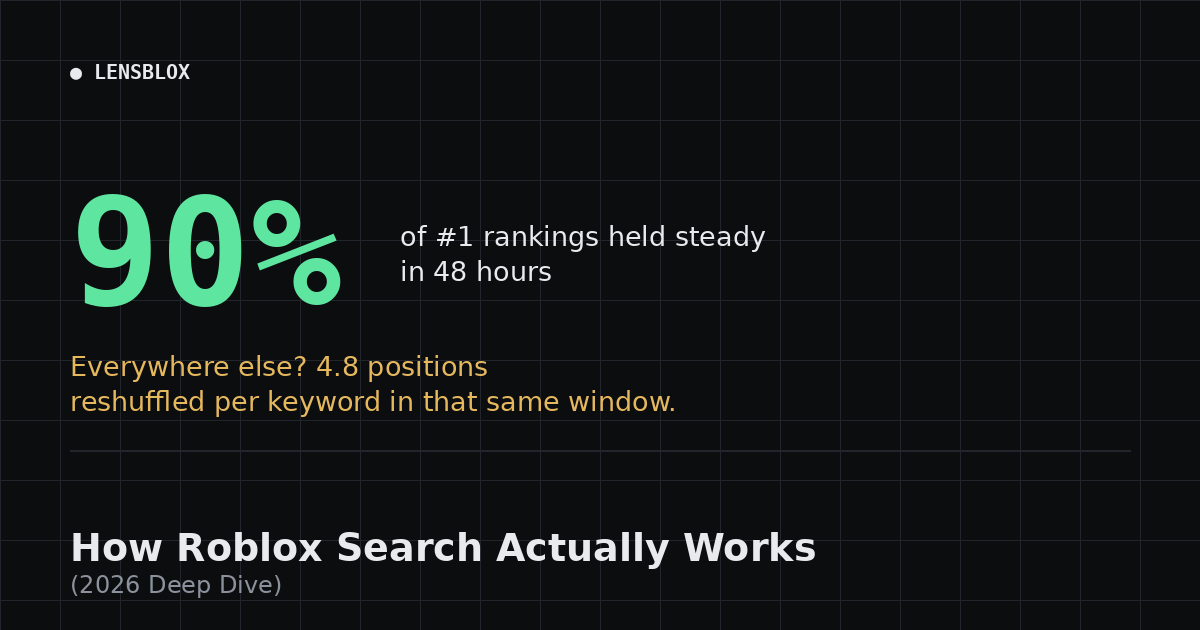
The #1 position is unusually stable. Across a 48-hour tracking window, roughly 90% of top-ranked results held their position. Whatever signal earns the top spot for a given keyword tends to be durable, not something that flips day to day.
Positions 2 through 10 are far more volatile. The same tracking period showed an average of 2.5 new entrants and 4.8 reshuffled positions per keyword within just 48 hours. This is the zone where competition is genuinely winnable — the top spot for a popular term may be locked in, but the rest of the page is actively shifting.
Raw player count does not directly determine position. This is the finding that contradicts the most common assumption in the developer community. For the search term “tycoon,” the #1 ranked result had fewer live players than the result sitting in 9th place. If search ranking were simply sorted by concurrent players, that result would be structurally impossible — it isn’t, which means something other than CCU is doing the sorting. Our full breakdown of player count and why it doesn’t correlate with ranking covers this in more depth.
What does appear to matter, based on these patterns, is relevance and competition specific to each keyword — how directly a game’s title and metadata match the term searched, weighed against how many other games are competing credibly for that same term. This is closer to how traditional search engines rank pages than most developers assume, and it means the game with the most players isn’t automatically the game most relevant to a specific search.
What We Know About Autocomplete
Roblox’s search bar also suggests terms as you type, pulling from real query patterns rather than a static list — and the order those suggestions appear in carries its own signal. We go deep on what autocomplete reveals, and how to use it for keyword research, here.
Keyword Stuffing: A Real, Observable Pattern
Titles that repeat a keyword unnaturally, paired with low engagement quality, do show up ranking in top-10 positions in real captured data — despite objectively weaker signals than competitors around them. Whether this reflects a genuine loophole or a temporary gap the algorithm hasn’t caught up to isn’t fully clear, but the pattern is real and observable. We cover exactly what this looks like, with real examples, here.
Why This Matters More Than It Used To
Whatever happens with Discover and its ongoing algorithm changes, search remains a stable, keyword-driven system that isn’t subject to the same personalization or retention-weighting shifts. A developer who understands what actually drives search ranking has a lever that doesn’t move every time Roblox tweaks its recommendation engine — which is exactly the gap the rest of our SEO guide is built to close.
Frequently Asked Questions
Does Roblox publish an official ranking algorithm for search? No. Everything here is derived from observed patterns in real search results over time, not an official specification — Roblox hasn’t published how search ranking is calculated.
If CCU doesn’t determine search rank, what should I actually track? Relevance signals (how well your title and description match the keywords players actually search) and competitive positioning for specific terms matter more than raw player count. Watching how your own ranking moves for target keywords over time is more useful than watching CCU alone.
Is search ranking the same worldwide, or does it vary by region? Roblox’s search and autocomplete systems appear to be locale-aware (adjusting language and regional relevance), so ranking for the same keyword can differ meaningfully between regions.
How often do search rankings change? Top positions are relatively stable over short windows, but positions just below the top spot can shift meaningfully within 48 hours — treating a single check as permanent is a common mistake.
Roblox’s search bar is one of the least documented parts of the entire platform. Ask ten developers how it decides what ranks first, and you’ll get ten different theories — most of them folklore passed around the DevForum rather than anything actually verified against real data. This guide is built from direct observation of Roblox’s own search results over time, not speculation, and it covers what genuinely determines ranking, why the metrics most developers chase don’t correlate with it the way they assume, and where the real evidence points instead.
Search and Discover Are Two Different Systems
This is the single most important distinction to get right, and most explanations blur it entirely. Roblox has two separate surfaces where players find games:
The Discover feed is a personalized recommendation surface — the scrolling home screen of suggested experiences, tailored to each player’s history. In July 2026, Roblox confirmed a major overhaul to this specific system, shifting its weighting toward session return rate (the percentage of players who come back within 24–72 hours) rather than raw concurrent player counts. We break that change down in full here.
Search, by contrast, is what happens when a player actively types a keyword. It isn’t personalized the same way, and it isn’t governed by the same ranking signals. A game can be thriving in Discover and still rank poorly for the exact terms players would search for it by — and vice versa. Conflating the two is the root of most bad advice on this topic: a tip that genuinely helps Discover placement (like retention-focused features) has no guaranteed effect on search ranking, and optimizing a game’s title or description for search relevance does nothing for Discover’s recommendation weighting. They’re related in that both determine discoverability, but they are not the same system, and treating them as one is why so much developer advice contradicts itself.
What Actually Determines Search Ranking
Based on tracking real search results across 35 keywords over time, a few patterns hold consistently:
The #1 position is unusually stable. Across a 48-hour tracking window, roughly 90% of top-ranked results held their position. Whatever signal earns the top spot for a given keyword tends to be durable, not something that flips day to day.
Positions 2 through 10 are far more volatile. The same tracking period showed an average of 2.5 new entrants and 4.8 reshuffled positions per keyword within just 48 hours. This is the zone where competition is genuinely winnable — the top spot for a popular term may be locked in, but the rest of the page is actively shifting.
Raw player count does not directly determine position. This is the finding that contradicts the most common assumption in the developer community. For the search term “tycoon,” the #1 ranked result had fewer live players than the result sitting in 9th place. If search ranking were simply sorted by concurrent players, that result would be structurally impossible — it isn’t, which means something other than CCU is doing the sorting. Our full breakdown of player count and why it doesn’t correlate with ranking covers this in more depth.
What does appear to matter, based on these patterns, is relevance and competition specific to each keyword — how directly a game’s title and metadata match the term searched, weighed against how many other games are competing credibly for that same term. This is closer to how traditional search engines rank pages than most developers assume, and it means the game with the most players isn’t automatically the game most relevant to a specific search.
What We Know About Autocomplete
Roblox’s search bar also suggests terms as you type, pulling from real query patterns rather than a static list — and the order those suggestions appear in carries its own signal. We go deep on what autocomplete reveals, and how to use it for keyword research, here.
Keyword Stuffing: A Real, Observable Pattern
Titles that repeat a keyword unnaturally, paired with low engagement quality, do show up ranking in top-10 positions in real captured data — despite objectively weaker signals than competitors around them. Whether this reflects a genuine loophole or a temporary gap the algorithm hasn’t caught up to isn’t fully clear, but the pattern is real and observable. We cover exactly what this looks like, with real examples, here.
Why This Matters More Than It Used To
Whatever happens with Discover and its ongoing algorithm changes, search remains a stable, keyword-driven system that isn’t subject to the same personalization or retention-weighting shifts. A developer who understands what actually drives search ranking has a lever that doesn’t move every time Roblox tweaks its recommendation engine — which is exactly the gap the rest of our SEO guide is built to close.
Frequently Asked Questions
Does Roblox publish an official ranking algorithm for search? No. Everything here is derived from observed patterns in real search results over time, not an official specification — Roblox hasn’t published how search ranking is calculated.
If CCU doesn’t determine search rank, what should I actually track? Relevance signals (how well your title and description match the keywords players actually search) and competitive positioning for specific terms matter more than raw player count. Watching how your own ranking moves for target keywords over time is more useful than watching CCU alone.
Is search ranking the same worldwide, or does it vary by region? Roblox’s search and autocomplete systems appear to be locale-aware (adjusting language and regional relevance), so ranking for the same keyword can differ meaningfully between regions.
How often do search rankings change? Top positions are relatively stable over short windows, but positions just below the top spot can shift meaningfully within 48 hours — treating a single check as permanent is a common mistake.
Get the complete Roblox discoverability guide.
Everything in this article, plus the full strategy — built from real ranking data, not recycled advice. Free.