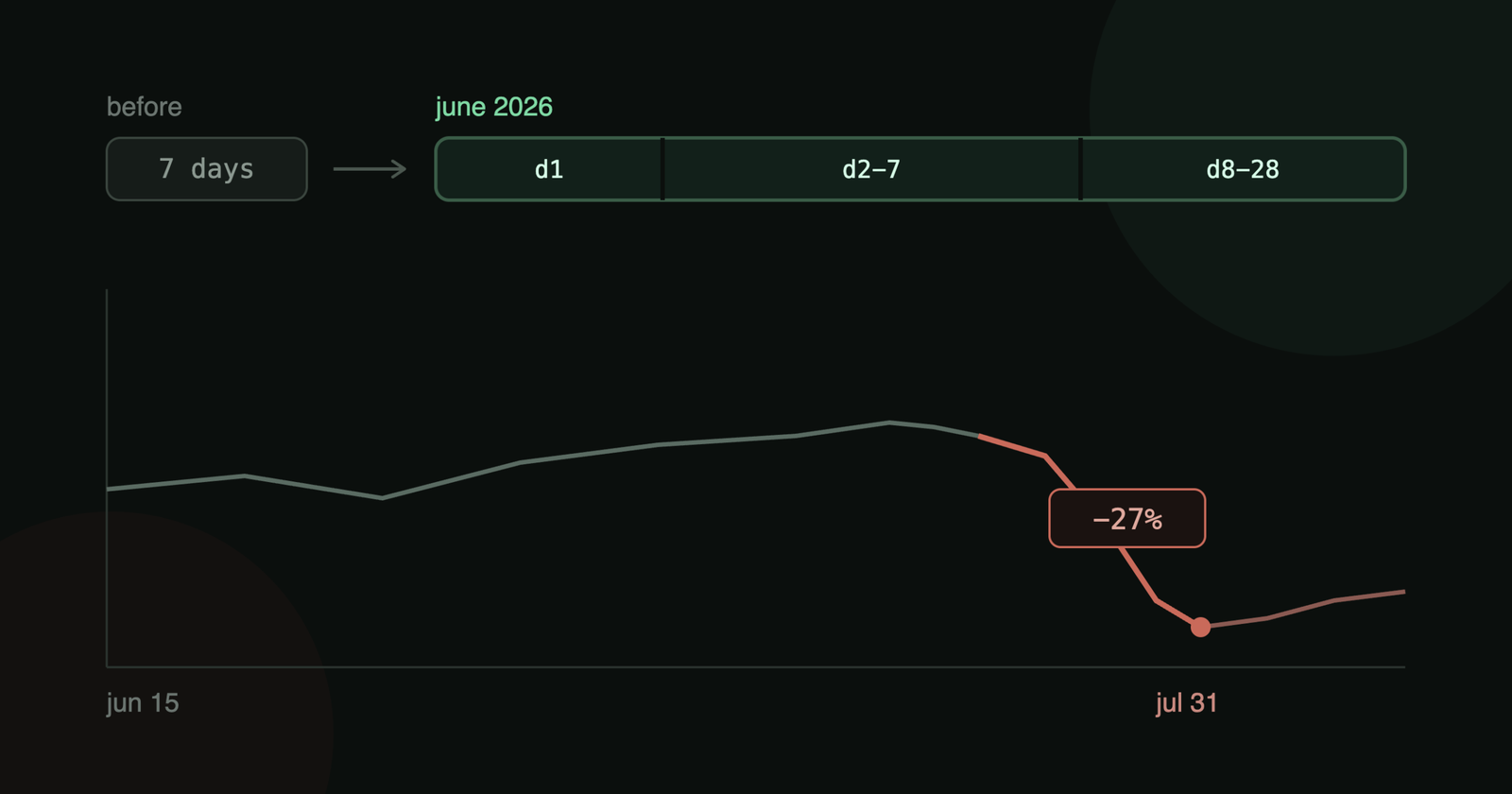
On June 15, 2026, Roblox published a newsroom post that quietly rewrote the rules for how games get discovered on the platform — and by early August, that same change had wiped roughly $9 billion off Roblox’s own market value in a single trading day. If you’re a developer trying to understand what actually changed and what to do about it, here’s the full timeline, based on Roblox’s own announcement and the earnings fallout that followed.
What actually changed: The 7-day to 28-day shift
Roblox’s official announcement, titled “Optimizing Discovery: How Great Games Reach Millions of Players on Roblox,” expanded the evaluation window the Recommended For You algorithm uses to judge a game’s performance — from a 7-day view to a full 28-day view. In practice, that means the algorithm no longer asks “did this game do well this week?” It asks whether players are still coming back a full month later, scored across three separate buckets: Day 1, Days 2–7, and Days 8–28.
Roblox also did something it hasn’t historically done: it published the full list of ranking signals and their relative importance directly to creators, rather than leaving developers to reverse-engineer it from forum speculation. The exact signal breakdown — play-through rate, first-play bounce rate, play days per user, and playtime per user as the top tier — is covered in full in our SEO guide, and it’s worth understanding that those specific signals are a direct result of this June update, not a general best-practices list someone assembled independently.
This wasn’t sudden. Roblox had been publicly testing algorithm changes aimed at rewarding long-term retention since at least April 2026, with CEO David Baszucki confirming on social media that the company was “testing algorithm improvements to ensure games that retain players long-term can be discovered by the largest possible audience.” June 15 was the official, global rollout of that testing.
Six weeks later: The earnings report that confirmed the trade-off
On July 30, 2026, Roblox reported second-quarter earnings. Revenue rose 36% year-over-year to $1.47 billion, and daily active users climbed 10% year-over-year to 123 million. On the surface, healthy growth. But bookings — the actual measure of what players spent — grew only 8%, landing at the low end of Roblox’s own guidance, and DAU had actually slipped from the 132 million reported the previous quarter.
Management didn’t frame this as a miss they didn’t see coming. Roblox explicitly attributed the shortfall to the June discovery algorithm change — a deliberate decision to prioritize long-term retention over the kind of short-term, high-monetization viral spikes that used to drive bookings. CFO Naveen Chopra described it as the platform steering players toward “new and evergreen experiences with lower hourly monetization” instead of the vintage viral titles that had driven spending in prior quarters. Roblox also guided third-quarter bookings down 14–18% year-over-year — the first time the company has ever guided to negative bookings growth — and withdrew its full-year 2026 outlook entirely.
July 31: Wall Street’s reaction
The market’s response was severe. Roblox shares closed down roughly 27% on July 31, 2026, at $35.60 — the company’s worst single-day trading drop on record, erasing approximately $9 billion in market value. Multiple sell-side analysts downgraded the stock in the days that followed, citing the algorithm shift, new age-verification requirements, and softer monetization among under-13 users as compounding headwinds.
For developers, the market reaction is a useful signal in its own right: it’s confirmation, from Roblox’s own financial disclosures, that this algorithm change is a real, structural shift in what the platform rewards — not a minor tweak that will quietly revert once the next update ships.
What this means If you’re building on Roblox
A few practical implications follow directly from the timeline above:
- A single viral spike is now worth less than it used to be. Games built around a short-term monetization burst — the kind of “vintage viral” title Roblox’s own CFO referenced — are precisely what this update deprioritizes. If your growth strategy leans on a big launch moment rather than sustained return visits, expect Discover placement to be harder to hold onto than it was before June.
- The 28-day window rewards patience over speed. A game that’s slowly building a loyal, returning audience now has a longer runway to prove that out to the algorithm than it did under the old 7-day model. This is also why raw CCU alone remains a poor proxy for algorithmic favor — a large one-time spike doesn’t carry the weight it once did.
- Search and Discover are still separate systems. This update specifically targets the Home page’s Recommended For You algorithm. Roblox’s search bar still ranks primarily on keyword relevance rather than the retention signals discussed here — worth remembering before assuming a Discover-focused fix will move your search ranking too.
Frequently asked questions
When exactly did Roblox change its discovery algorithm? Roblox officially announced and rolled out the change on June 15, 2026, though public testing had been underway since at least April 2026.
Why did Roblox stock crash if the algorithm change wasn’t news by July 31? The algorithm change itself was announced in June. What moved the stock on July 31 was Roblox’s Q2 earnings report confirming, with real numbers, how much that change was suppressing near-term bookings — plus a third-quarter guidance cut that caught investors off guard.
Does this affect Roblox search rankings too, or just Discover? The June update specifically targets the Home page’s Recommended For You algorithm. Search ranking is a related but separate system, driven primarily by keyword relevance rather than the 28-day retention signals covered here.
Should I change my monetization strategy because of this? That depends on your game and goals — but it’s worth knowing that Roblox itself has confirmed, in a public earnings call, that games optimized for quick monetization are now less favored by discovery than games optimized for long-term retention.
Discovery placement is one half of getting found on Roblox. LensBlox tracks the other half — where your game actually ranks in Roblox search — with the methodology behind every score shown.
Get the complete Roblox discoverability guide.
Everything in this article, plus the full strategy — built from real ranking data, not recycled advice. Free.